
It takes only 30 minutes to fly from Flagstaff to Phoenix, Arizona; but 30 minutes can be enough to change your life.
The propellers hadn’t yet begun to spin as the flight attendant, who resembled Hugo Chávez, gave his safety speech. “If you are seated in an exit row…” he said, his words becoming drowned in static. “If you are seated in an exit row…” he repeated, but this time his words were cut off by a screech. Then his microphone went dead.
We could still hear him, but in the event of an emergency, the captain would not be able to communicate with the cabin from behind the locked cockpit door. So after only a few minutes, all 40 or so passengers were informed of the problem and allowed to “deplane”.
The regional airline’s staff of three — one boss, one experienced employee and one apparently recent hire (“MUC? Where’s that?” he’d asked me) — had their hands full dealing with the unexpected. An electrician was not available. Passengers showed up for the next flight, but instead of appropriating their (identical) airplane, the staff let them board, giving the remaining seats to the most insistent of the original group.
To the 14 of us left behind, the situation looked grim. We’d already been at the airport for four hours. The next scheduled flight was three hours away — too late for most of us to reach any connection to our far-flung destinations.
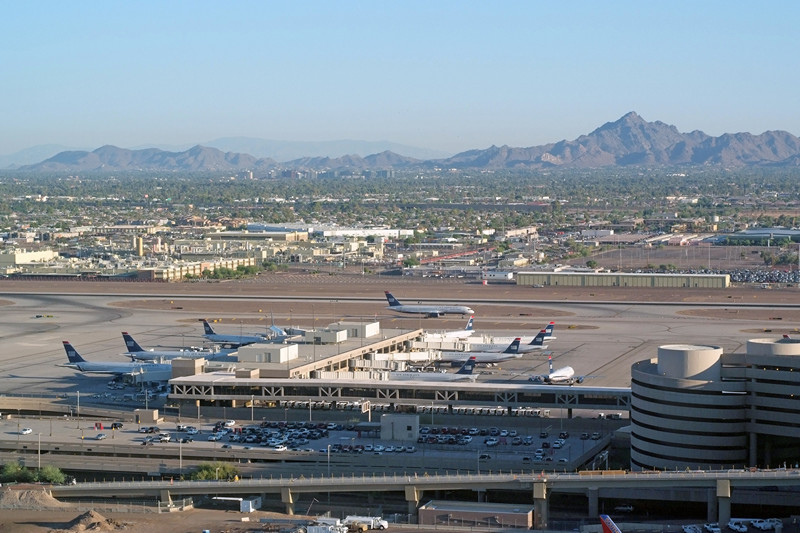
The US Airways terminal at Sky Harbor Airport in Phoenix. Photo: Mike Pilewski
One loose wire
As the harried staff typed away at their computers and made arrangements by phone with the associated major carrier, US Airways, the passengers began to commiserate. “Unbelievable!” they said. “Because of one loose wire, the whole plane was grounded.” “It’s a half-hour flight. If we were going to crash, we wouldn’t need the captain to tell us.” After a few minutes, we were smiling at each other and laughing about the absurdity of the situation.
The airline staff did apologize to us individually, profusely and repeatedly, for altering history: the hotel rooms lost, the loved ones not met, the Saturday we wouldn’t get back. And I think we did appreciate the attention to safety.
Because the rebooking went so slowly, however, taking about 15 minutes per passenger, the first of us were sent to a waiting taxi for the 240-kilometer ride to Phoenix. The others wished us well as we rode off to our unplanned accommodation, paid for by a voucher. The airline, which only months earlier had emerged from bankruptcy, spent about $150 on each of us.
Like old neighbors
Later that afternoon in Phoenix, the rest of the “US Airways 14” began arriving in twos and threes. It was like a reunion with old neighbors. We shared more of our stories — what we’d been doing in Arizona, where we were from, where we were headed: the young couple from Alabama in their T-shirts and baseball caps; the retirees from Virginia; a tiny, white-haired lady from England, whose appearance and sense of humor reminded me of Dr. Ruth Westheimer.
In those brief moments, we shared the bond of a common experience. I thought of us as being like the Oceanic Six from the TV series Lost: individuals brought together by unseen forces, helping each other to make a situation less unbearable.
Similar moments occur during the inevitable delays with Deutsche Bahn. In Germany, it usually takes a major inconvenience for strangers to start talking to each other, and I’m usually the one to initiate it with a funny remark or words of sympathy. So in Flagstaff, I automatically felt the same duty to get things rolling.
As we left our hotel in Phoenix the next morning, I was surprised to find I was known to the whole group — even to those I hadn’t met — as the guy who lived in Germany. And there was another benefit. My parents were among the US Airways 14. Our shared vacation, which had lasted only a week, was supposed to be over in 30 minutes. Instead, we got to spend an extra day together.


