
The Pentagon announced yesterday that its special forces had killed Abu Sayyaf, a top Islamic State commander in Syria. There’d been a firefight at his compound. The special forces seized a substantial amount of useful information.
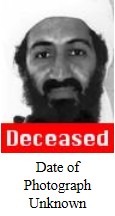 Four years and two weeks ago, we were told the same things about Osama bin Laden. There were some serious holes in that story, which changed daily, and as we’re learning now, that story may not even have been true.
According to investigative journalist Seymour Hersh, yes, the special forces did kill bin Laden. But no, there was no firefight. No, bin Laden was not armed. No, he did not use one of his wives as a shield. No, bin Laden was not running a command center, and no useful information was recovered. No, he was not buried at sea. Most importantly, the CIA had not found him. Pakistan not only knew that bin Laden was living in Abbottabad; it had kept him there since 2006. The raid was of course coordinated with Pakistan.
“The White House’s story might have been written by Lewis Carroll,” Hersh concludes. His 10,356-word article in the London Review of Books offers a much more logical sequence of events than the often-changed official story, as well as plausible reasons for why the truth could not be told.
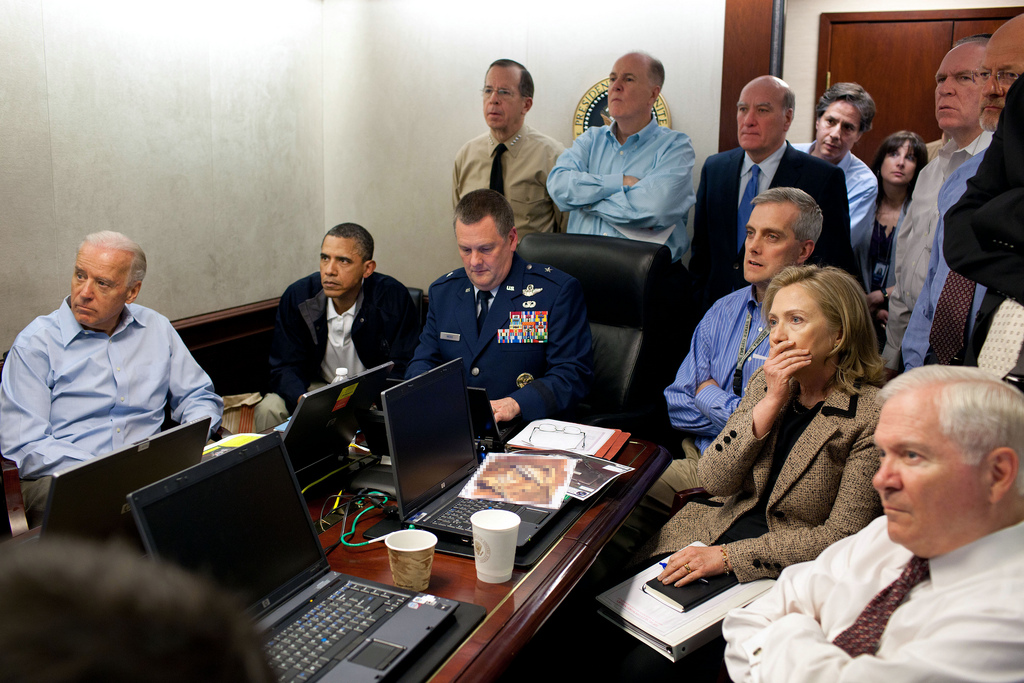
The White House national security team monitors the bin Laden raid in real time, May 1, 2011. Photo: Pete Souza/The White House
A different version of events
Hersh’s article claims:
• Bin Laden lived in the Hindu Kush mountains from 2001 to 2006. Pakistan’s intelligence agency, ISI, found him by bribing local people and brought him to Abbottabad.
• Pakistan has had to walk a fine line in terms of working with the US, which most of its citizens mistrust, and appeasing the radicals within its own borders. Pakistan could not simply hand over bin Laden, whom many Pakistanis considered a hero, without getting something in return.
• A senior ISI officer, acting alone, revealed bin Laden’s whereabouts to the US in 2010 in order to collect the $25 million reward the US was offering.
• Barack Obama wanted the raid for political reasons. Pakistan reluctantly agreed to it, on the condition that its cooperation would not be revealed. A cover story — that bin Laden was killed by a drone across the border in Afghanistan — would be put out a week after the fact, so as to be difficult to confirm.
• Top Pakistani military officials made sure that their military did not track or engage the US helicopters used in the raid. The ISI turned off electricity to bin Laden’s neighborhood and told the guards at his compound to leave as soon as they heard the helicopters. An ISI liaison officer guided the special forces into bin Laden’s house.
• Bin Laden was alone in the room, unarmed and cowering. The special forces came in and shot him to pieces. Accounts differ as to whether the pieces of bin Laden’s corpse were brought back to Afghanistan or dumped out of a helicopter on the way there, but the consensus is that there was no burial at sea.
• Because the special forces’ helicopter had crashed in bin Laden’s compound, attracting attention, Obama decided to ditch the story agreed to with Pakistan and announce right away that the raid had happened in Abbottabad. His speech had to be written in a hurry, and its inaccuracies — along with the need to protect those involved in organizing the raid — required more and more elaborate cover stories.
• The ISI held on to bin Laden’s wives and children, and did not allow the US to question them.
Not just any reporter
As soon as Hersh’s article came out, a former deputy director of the CIA and various other officials went onto every television network to disavow it. Repeatedly, viewers were told — even by some of the networks’ own correspondents — not to believe a respected journalist. That was to be expected.
Hersh is not just any reporter. He was the one who broke the story, in 1969, about US war crimes in Vietnam and the one who told the world, in 2004, about the torture of prisoners at Abu Ghraib in Iraq. In the latter case, his work was fiercely denounced by military and government leaders before official investigations proved him correct. Hersh also reported on the Bush-Cheney administration’s 2002 determination to invade Iraq and the NSA’s program of monitoring domestic phone calls.
Hersh’s latest article, if true, negates most of the film Zero Dark Thirty, which was based on the official story of the raid on bin Laden, much of it fed to the scriptwriters by the CIA. Among other things, the film pretends that useful information about bin Laden’s whereabouts was acquired through torture, when this was not the case at all.
Evidence still required
The White House, the CIA and the military have lied so many times in the “war on terror” that the burden of proof is on them. As to Hersh, however, extraordinary claims still require extraordinary evidence. Much of this month’s article is based on an interview with one unnamed individual — a “retired senior intelligence official” — along with information from a former special forces commander, two long-time consultants to the Special Operations Command, and sources inside Pakistan, and leans much more towards plausibility than towards evidence.
It is possible that Hersh, like other reporters, was fed yet another fake story. But NBC News says it has three sources that agree with him, and the many discrepancies between the various accounts — even between stories told by two of the men who shot bin Laden — mean that somebody is lying. This is a significant step towards finding the truth about bin Laden’s final moments. The story of the Islamic State commander, far less important, may never be known.


