
Yesterday was a time to reflect on a pioneering achievement. Sixty-five years ago, on June 11, 1948, the world’s first astronaut traveled to an altitude of 63 kilometers aboard an American V-2 rocket.
His name was Albert. He was a rhesus monkey.
Albert really was a pioneer. He was the first living organism to have flown to a significant altitude on a rocket, apart from seeds, spores and fruit flies. It would take another three years for the Soviets to send up a dog.
Albert’s mission was to deliver data on the effects of radiation, g-forces and microgravity on living organisms in space flight. He was anesthetized for the flight. Unfortunately, he had trouble breathing in the tiny capsule. The instruments failed to pick up any vital signs. Even before his parachute failed to open, Albert is believed to have made the supreme sacrifice.
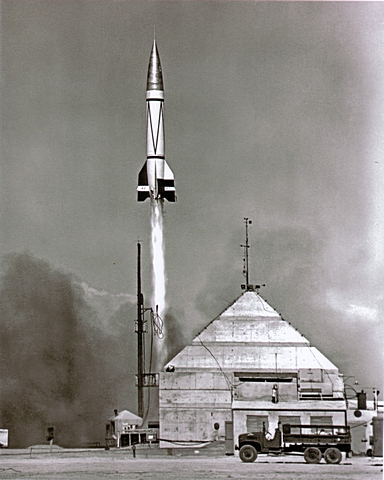
Albert II flies into space. Photo: Smithsonian National Air and Space Museum
The capsule, instruments and parachute were redesigned for the next monkey astronaut, Albert II, who flew a year later. Albert II made it to an altitude of 134 km, past the 100 km boundary of space. His vital signs proved that a large animal could survive the trip up, if not the trip down. His parachute, too, failed to deploy. Albert II died on impact.
Further Alberts did not fare any better. Albert III died at an altitude of 10 kilometers, when his V-2 rocket exploded. Albert IV died of parachute failure. So did Albert V.
Finally, a different type of rocket was used, allowing Albert VI to survive both the flight and the landing. However, he died of heat exhaustion two hours later. His capsule had sat too long in the desert sun of New Mexico before the recovery team showed up.
The survival of two cynomolgus monkeys, Patricia and Mike, on a further flight in 1952, failed to make up for previous simian losses — the flight was well below the threshold of space.
Animal-lovers were not amused
The message was clear: If you are a monkey, don’t get on any rockets. Animal-lovers wrote to NASA to complain about the carnage; some even volunteered to take the place of any further ape-onauts.
The message was clear: If you are a monkey, don’t get on any rockets
The recent introduction of polyethylene made it possible to do longer and better experiments using high-altitude balloons, so for six years, NASA kept animals off of rockets while it worked to improve the technology. In the meantime, it gave hamsters, cats and dogs balloon rides up to an altitude of 30 kilometers.
During the 1950s, the Soviets sent at least 20 dogs on suborbital flights. About half of them survived. In November 1957, the dog Laika became the first living creature in orbit. She lasted about five to seven hours before succumbing to stress and heat exhaustion. However, she had not been expected to live much longer anyway — there was no way of returning her to Earth.
From astrochimps to astronauts
In December 1958, the US resumed animal rocketry. A squirrel monkey named Gordo died of, again, a bad parachute. But in May 1959, Able and Baker — a rhesus monkey and a squirrel monkey, respectively — became the first monkeys to travel in space and successfully return.
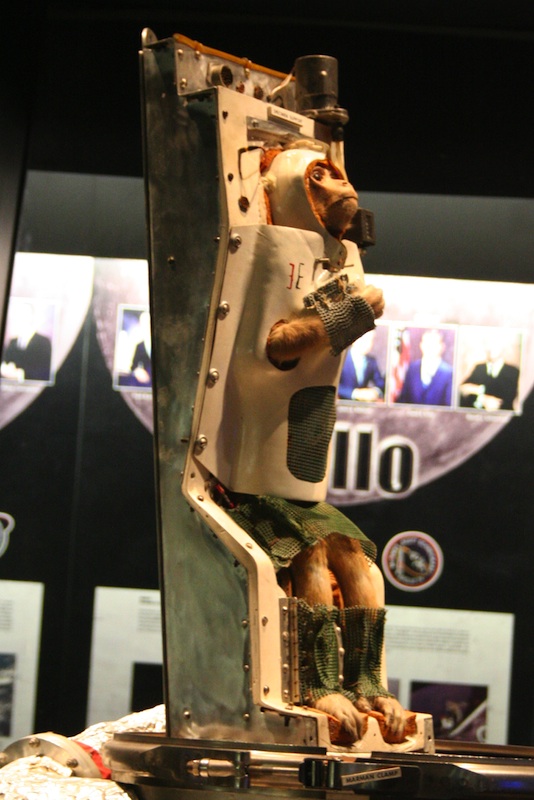
Able on display. Photo: RadioFan/Wikipedia
Able unfortunately died three days later during surgery to remove an infected electrode. She was stuffed and put on display at the National Air and Space Museum in Washington, DC. Miss Baker survived and lived in Alabama until 1984.
Rhesus monkeys Sam and Miss Sam also survived, as did Ham the Astrochimp. This gave the green light to Alan Shepard and other humans (including Yuri Gagarin a month before Shepard) to go into space in 1961. Another chimp named Enos participated in a dress rehearsal for the first US human orbital mission by John Glenn in 1962.
Half a century later, using animals in tests seems rather barbaric. But without the bravery of our simian astronauts and canine cosmonauts, would we ever have gone into space?


