
Each month in Spotlight magazine, I write about the anniversary of a historical event, such as the birth or death of an important person. Lately, though, I’ve been thinking about an anniversary that came and went this year. The important person was my grandfather.
Next Wednesday, two days after Halloween, is All Souls’ Day. The occasion is hardly celebrated now, but along with the rest of the Catholic community of Oil City, Pennsylvania, John Walter Pilewski would certainly have taken some time on that day to remember the dead. So I’ll carry on the tradition by remembering him.
My grandfather, born in 1906, was the son of immigrants. The whole neighborhood, in fact, was full of them; many still spoke more Polish than English. The house was full of Catholic iconography, and if you didn’t know what was for dinner, cabbage was always a good bet.
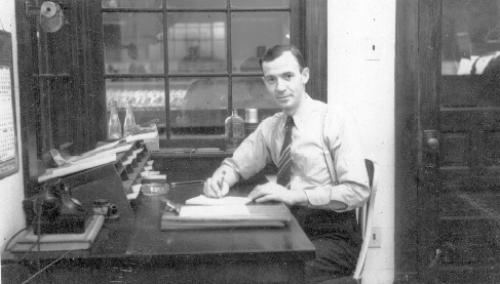
The New World offered a generous opportunity to anyone who was willing to work hard enough, and work hard my grandfather did. He was known for it — as a railroad employee in the 1920s, then later as traffic manager (workflow supervisor) at the local glass bottle company. He was knowledgeable and friendly. Those who knew him liked and respected him.
Five children — a typical family size for the time, but born during the Depression or the war — were a challenge to feed. Everything was reused: clothes were handed down, containers were washed out, bones and other scraps were saved for soup. By cutting back wherever possible, and by stretching its resources, the family got through this difficult time. Luckily, my grandfather was able to support them through his job.
In those days, you could walk to work — not because the distances were shorter, but because walking was what people did. It was the only exercise someone like my grandfather would get. Thin as a rail (like most people back then), he couldn’t have imagined our modern ideas about health. To keep going, he drank 20 cups of black coffee a day. Greasy food began to clog his arteries. And the stresses of work and family contributed to the high blood pressure he was probably born with — a condition that the medicines of the time could not have treated anyway.
In those days, there was no work-life balance. Life itself was work. When my grandfather was slaving away in the office, my grandmother was slaving away at home with her washboard and rug-beater. Vacation was a privilege of the wealthy. Doctors’ appointments were rare — and if the doctor came to see you, it was usually too late.
It was for my grandfather. He died at age 50.
This was long before my birth. All I know about him, I’ve written here — and I’m not even sure I’ve got all the details right. I know of only two photographs of him — one taken at a friend’s wedding, the other taken in his office. That in itself says a lot.
How different things are today, with the advances in medicine, an awareness of possible warning signs and legal limits to the number of hours we work.
Would those things have stopped him, though? Growing up in a Polish home, my grandfather probably knew the saying Praca nie zając, nie ucieknie. (Literally: Work is not a hare; it won’t run away. In other words, there will always be enough to do. There’s more to life than work.) The equivalent saying today might be the question “Do you work to live or live to work?”
I don’t know if either one would have made sense to him. Working hard was the best way he could support his family — immediately and down the road. My grandfather may have worked himself to death; but I like to think he worked as hard as he did so that I wouldn’t have to.


