
Recently, the American and German exchange students I advise were privileged to enjoy the company of Vice-Admiral Charles Martoglio, the deputy commander of United States European Command. Martoglio and his boss are in charge of 100,000 military and civilian personnel who operate across this entire continent.
Our group often meets with ambassadors, consuls, army generals, air-force colonels and important politicians, but their words have tended to be spoken cautiously and limited to familiar talking points. Usually we rely on the interpretation of political science professors to fill in the gaps.
Like some of our other recent speakers, however, Martoglio offered a refreshingly candid perspective. One can almost infer that, after a decade or so of confusing messages, the US government and military now recognize that they need to do more to explain America’s policies and actions, especially as they concern the world’s trouble spots.
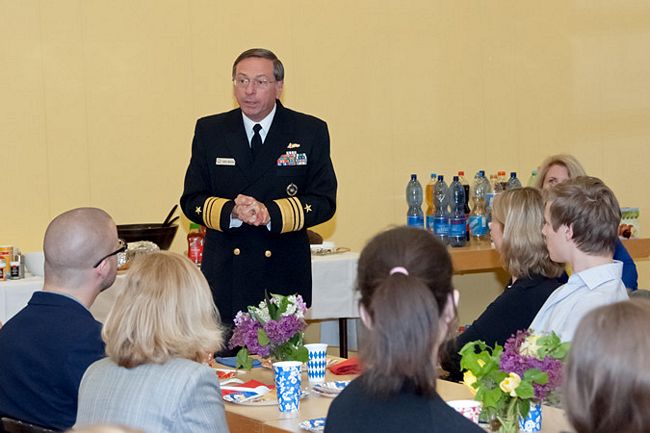
According to Martoglio, we don’t have as much to worry about as the news would have us believe. The next big conflict will not be in Korea, “despite what you’ve been hearing,” nor between China and Taiwan (it’s “never gonna happen” because of all the commerce at stake). He is, however, worried about North Africa and the Arab world. But even that can be kept under control. “The world today has more hot spots than ever before,” he said, “but the likelihood of massive conflict is way down.”
NATO, under the leadership of the United States (“the glue that holds NATO together”), has put an end to a thousand years of intra-European fighting, he said, but this hasn’t been done altruistically. “All nations act in their own self-interest all the time, without exception,” he said, pausing to repeat that sentence. “We’d leave if Germany ever said it’s time to go. We would.”
Certainly, we’d heard elements of this before, as asides or admissions, but I can’t recall a time when it was all said by one person, this openly and this close to the top.
The admiral then turned from the success of NATO to talking about personal success.
• Rule number one, he said, is “Accomplish the mission. Everything else of value is in support of mission accomplishment.”
• “Know your job better than anyone else.” Your expertise will get you noticed.
• “Focus on executing the fundamentals of your job, every day. Routinely doing the ‘routine’ generates the readiness to accomplish the mission, especially on short notice.”
• “Work for the best people you can find. They will get to the top and pull you along.”
• “Always be adding to your goodwill reservoir. Everyone needs to draw on goodwill at some point.” In other words, help others, and they will help you.
• “While people may remember what you said, they will always remember how you made them feel.”
• “Practice and use your writing and speaking skills often.”
• “Every job is a sales job and every discussion is an interview.”
• “It’s never as good as it seems, nor as bad, so don’t go to emotional extremes.”
• “Use common sense and good judgment daily and you’ll go far.”
That night, the students and I stayed up, talking, till 3 a.m. Various things the admiral had said kept coming back to us. Most of them we could agree with. But do all nations act in their own self-interest? That might depend on their leaders and the interests they have in mind. And do the rules for success apply outside a closed, achievement-based system like the military? The business world has its share of inflated or fraudulent résumés, cronyism, nepotism, corruption and incompetence. The academic world has its cheats. The sporting world has Lance Armstrong. All of this can make it hard for good people to be successful. Perhaps the rules need to be followed at every level.
Say what you will about us Americans, but you have to admit we’re optimistic. I’ll take the admiral’s rules for success as a blueprint for an ideal world — one he’s helping to create, even if it is in America’s own self-interest.


