
Our hero has crash-landed on an alien planet! Spaceman Spiff crawls from the smoking wreckage of his ship, but he is soon captured by hideous creatures. Their leader — an octopus with the head of an insect — tells him, “You have knowledge we need. Cooperate, and we’ll kill you rather painlessly.”
“What is it you want from me?” Spiff asks defiantly.
“A summary of Lewis and Clark’s expedition to the Pacific!” the creature demands.
Suddenly the perspective changes, and we see we’re on Earth, in a classroom. Spaceman Spiff is the boy Calvin, and the alien is his matronly teacher, Miss Wormwood. “You didn’t read the assignment, did you?” she says.
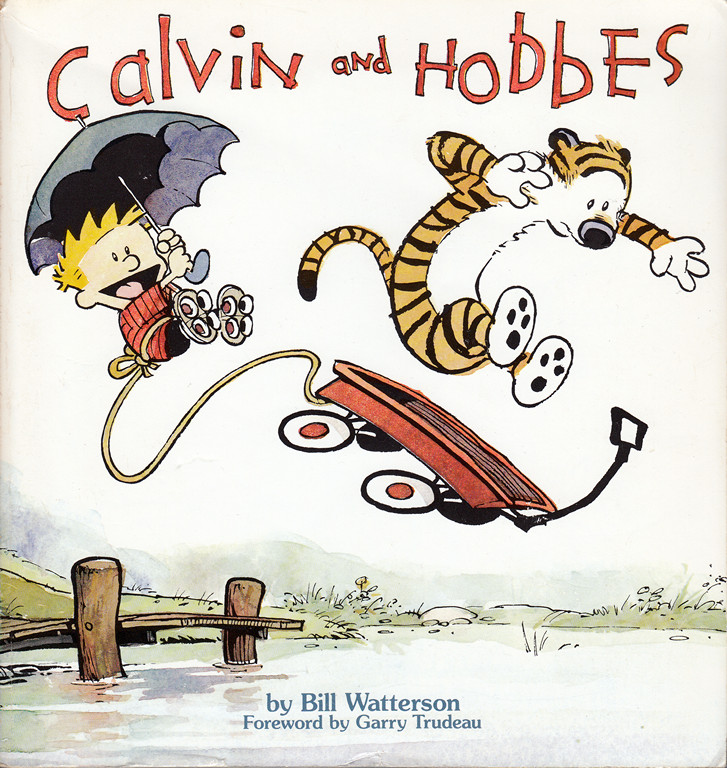 Bill Watterson’s comic strip Calvin and Hobbes gave us a new way of looking at the world when it first appeared 25 years ago, on November 18, 1985. It was an answer to Peanuts, whose brilliant social commentary in the 1950s and ’60s had faded, leaving that strip trite, feeble, and repetitive. With Calvin and Hobbes, you never knew what was going to come next.
Nor did Calvin’s parents. “Bad news, Dad. Your polls are way down,” Calvin tells his father, who generally prefers not to be disturbed. “You rate especially low among tigers and six-year-old white males. If you want to stay ‘dad’, I’d suggest you adopt some key planks to your platform,” he continues. “Of those polled, virtually all favor increased allowances and the commencement of driving lessons.”
Ignored and misunderstood by adults, Calvin is saved by his overactive imagination
Ignored and misunderstood by adults, Calvin is saved by his overactive imagination. A cardboard box becomes a time machine. Turned upside down, it clones people. Best of all, Calvin’s faithful companion — a stuffed tiger named Hobbes — is real (except when adults are in the frame).
Hobbes is the perfect alter ego, offering a calmer, more rational viewpoint. Together, the two are able to discuss the great questions of human existence. For example, Calvin’s classmate Susie. Should she be tormented (as Calvin prefers) or kissed (as Hobbes would like)?
Although he’s a figment of Calvin’s imagination, Hobbes is smarter than the boy — except when he does Calvin’s math homework for him.
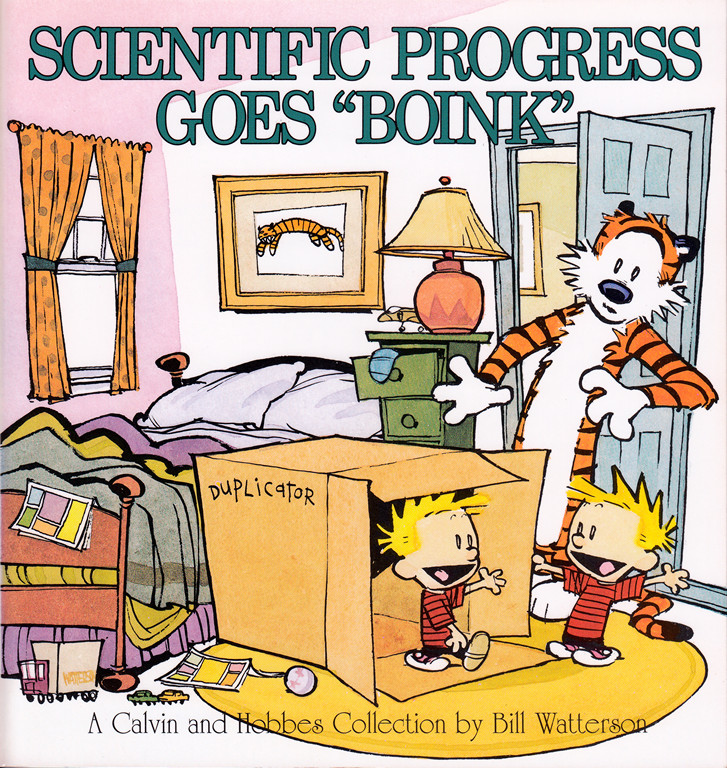 The dialogue, too, is often priceless. Calvin and Hobbes are carving a pumpkin to make a jack-o’-lantern for Halloween. Calvin draws a face on the vegetable, then pulls out a large knife and shouts, “OK, Jack! Time for your lobotomy!”
Ironically, the best thing about Calvin and Hobbes is that it ended. After ten years, Watterson said that he had done all he could in that medium and that it was time to do something different. There is great wisdom in this. The strip is still as fresh and funny as it was on its last day in December 1995. It replaced Peanuts, but it didn’t become Peanuts.
The animated series South Park soon combined the philosophy of the early Peanuts with the crassness of Calvin and Hobbes. But after 13 years, that show has done just about all it can do. So any minute now, something will come along to replace it. It’ll be interesting to see what that is.


