
You can probably imagine which story has been dominating the news in the United States for the past week. That’s right: the one about the problems with the new health-insurance program popularly known as Obamacare.
The story that’s been dominating the news in Germany is also being reported in America, though not always as front-page news. That story, however, is much more important and could be far more damaging to the Obama administration and to the United States in the long run. Think about it: all it took for President Richard Nixon to almost be thrown out of office was to wiretap his enemies. What could the consequences be of wiretapping your friends?
Other countries would be punished for spying like this
If a different country were caught spying to this extent, its embassy would be closed and its staff deported. That country’s military bases would be confiscated; diplomatic recognition might be withdrawn; there could be sanctions.
The German interior minister, who was not at all concerned when only the 80 million Germans whose last name is not Merkel were being spied on, and the location of the spying was not known, is now threatening the embassy staff with criminal charges, should the spying be proven. We’ll see if that happens; he certainly won’t be getting any information from the Americans.
Did they really not know?
A lot of people in important positions, curiously, don’t seem to know the things they should.
US ambassador to Germany John B. Emerson was on German television this week, claiming not to know what was happening under his own roof. President Barack Obama claimed not to know that Angela Merkel’s phone was being tapped. All summer long, General Keith Alexander, head of the NSA, and James Clapper, director of national intelligence, denied to Congress that their agencies had engaged in any wrongdoing — until evidence proved the contrary.
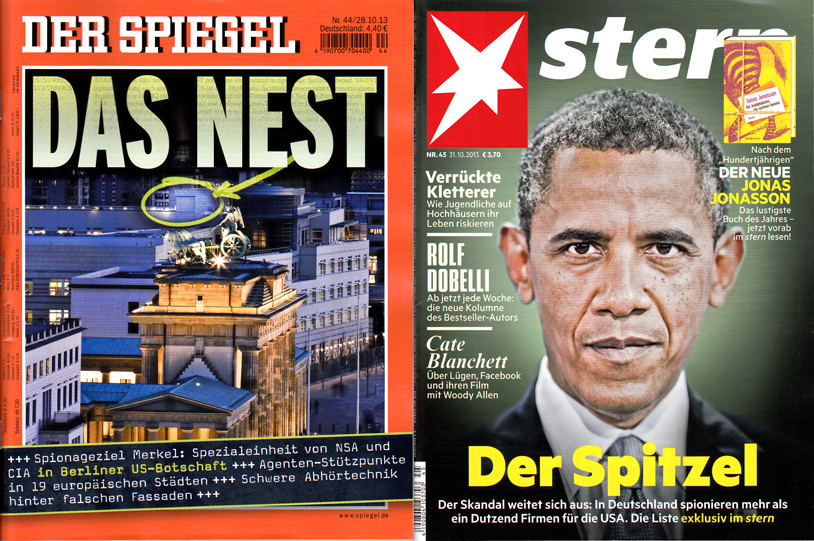
The scandal through the eyes of the German media: left, the US embassy as a “den of spies”; right, Obama as “the informant”.
And was Merkel herself — a native of Stasiland — so naive to think she would not be targeted by a program put in place by George W. Bush and Dick Cheney? As the admiral reminded us, “all nations act in their own self-interest all the time, without exception,” and the interests of the US are not the same as those of other countries, even its allies.
So if the US is spying on everyone — and bear in mind, the NSA’s new secret facility in Utah will be able to store almost one terabyte of data on each of the world’s seven billion people — that’s not a problem for those who have nothing to hide, right?
The Stasi also felt people should have nothing to hide
Well, didn’t the Stasi use to say that? Take out the word “US” and put in “Stasi” or “Russia” or “China” instead, or even the name of your own country. If it’s not all right for them to spy on you, it’s not all right for the US either.
The difference to the real Stasi — and it’s a big one — is that in the United States, as I write this, journalists are not being rounded up and political prisoners are not being held. But when the NSA has a full dossier on everyone, might that not prevent some people from running for political office, expressing their opinions or participating in protests — either for fear of blackmail or of winding up on a list of some sort?
What will change?
Only about 10 percent of Spotlight Online readers say they still trust the United States as before. More than 50 percent say the US should not be trusted.
My guess, however, is that on the state level, nothing will change. The US is too powerful, and German politicians too spineless, for anything meaningful to happen.
The secret negotiations on the transatlantic free-trade agreement are almost complete, and the corporations that expect to profit from it will put pressure on the politicians not to let this scandal get in the way. Never mind that the US probably secured advantages for itself by tapping the phones of the European negotiators.
Most importantly, though, if the story doesn’t disappear soon, journalists might start asking questions about the activities of Germany’s own espionage agency, the BND. On Tuesday, General Alexander told Congress that most of the data the NSA had on European citizens was being collected by their own countries’ intelligence services. What if he’s right?


