
Editor’s note: I wrote this article, like those prior to it, in my capacity as Online Editor of Spotlight magazine.
Every so often, we hear from a reader who insists that we are absolutely, flat-out, dead wrong about something. This is fine; people are entitled to their opinions, and we would really like to hear them. Occasionally there has been an oversight, and we are happy to correct it. At other times, we still feel the evidence speaks more for the argument that we have put forward.
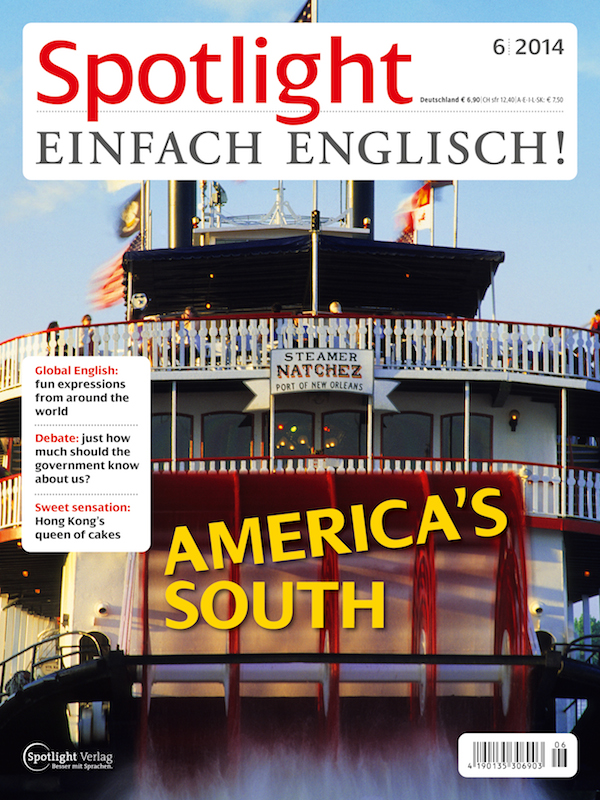 The latest example of this came from long-time subscriber Eva L. of Malmö, Sweden, who expressed her disappointment at the words “America’s South” on the cover of Spotlight 6/2014. She wrote:
“The southern states of the US … would rather make up the ‘US South’, while ‘America’s South’ consists of the southern parts of Argentina and Chile.”
The tone was much friendlier than that of a previous letter in response to an article about New York City in Spotlight 10/2012. “Don’t you all know,” wrote first-time reader P. Miller of Straubing, “that ‘America’ is a continent and not the name of a state?” P. said he or she was “appalled” at this “linguistic, factual and political error”.
In both cases, we respectfully disagree.
English is different
Historically, “America” did refer to both continents, but that usage is no longer common in English. The reason is that English now does something that other languages do not. It refers to the double continent of North and South America as the Americas. The United Nations does this. Major publications such as The Economist do this. It avoids confusion.
The corresponding adjective for the whole land mass is pan-American. There is a problem, though, in that there is no single word for “residents of North and South America” or “inhabitants of the Americas”. While it can be argued that all of these people are Americans, that point will not automatically be clear to native speakers of English.
When people from the US shorten “the United States of America” to “America” and call themselves “Americans”, it’s not an expression of arrogance, imperialism or Manifest Destiny; it is done for convenience. There are simply no other words available.
The British referred to us as “Yanks” or “Yankees” up until World War I, even though in the United States the term meant just people from the northeastern US. From time to time, someone tries to invent a fanciful term like “Usan” or “Unitedstatesian” or “US-American”, but none of these have caught on. (Six syllables? You must be joking.)
Outside of the US, Canada, Belize and Guyana, everyone else on the double continent speaks Spanish, Portuguese, Quechua or other languages, which offer their own ways of approaching this problem. Telling someone you’re from the United States may not even make things clear. In Spanish, it’s Estados Unidos. There’s also a second Estados Unidos, known by its short form, Mexico.
A bigger problem
When you think about it, geographical names everywhere are mixed up. Germany and Austria both referred to themselves until recently as die Bundesrepublik. People often say England when they mean Britain, and Holland when they mean The Netherlands. The Amish, who are mistakenly called Pennsylvania Dutch, refer to other North Americans as “the English”.
Native peoples, unfortunately, had no name for the whole of North and South America. There is, however, another European name.
It was a German cartographer, Martin Waldseemüller, who first wrote the name “America” on a map in 1507. He did it in homage to Florentine explorer Amerigo Vespucci who, unlike Christopher Columbus, realized that he was not in Asia.
Columbus still had his supporters, though, and so Columbia came to be a poetic alternative to “America”. The District of Columbia, British Columbia, the country of Colombia and hundreds of other places and institutions (such as Columbia University) were named this way.
But… but… the country of Colombia! Don’t they know that their name refers to two continents, not to a single country?
Please, I say, let it go.
Language note: The headline “America’s South” was no doubt chosen for its length, to fit on the cover. It is something a British person would say. Someone from the United States would refer to “the American South”, “the Southern US”, or (with apologies to Eva L.) simply “the South”.


