
When my uncle moved from Pennsylvania to North Carolina, he no longer had to shovel his driveway. Instead, he almost got hit by a tornado.
“One of the first tornadoes touched down just nine miles [15 km] north of us,” he wrote in an e-mail this week. One of the first, that is, of 25 tornadoes that hit the state on Saturday. Altogether, 230 tornadoes formed in seven states over a three-day period. Another sign of the end times, perhaps?
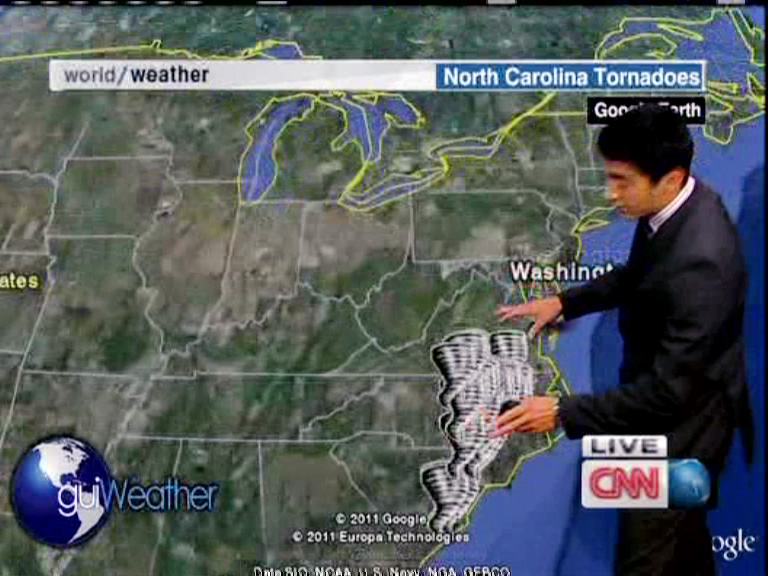
Even for the United States, which has more tornadoes than all other parts of the world combined, this was extreme. Giant “supercell” storms spawned entire families of tornadoes, each of which carved its own path of destruction through neighborhoods, trailer parks and shopping centers.
The number of houses destroyed was relatively small — 130 or so — but many neighborhoods were made inaccessible by fallen trees, downed power lines and lots of debris.
On Tuesday, Barack Obama declared large parts of the state a disaster area. People who have lost their homes will get federal grants and loans to cover repairs and property losses.
When we hear about tornadoes, we usually think of Tornado Alley, a portion of the Midwest around Kansas that is hit the worst, mainly in May and June. But any state can be affected. Come to think of it, my uncle was almost hit by one when he lived in northwestern Pennsylvania. And, in fact, so was I.
It was May, and I was bicycling north across Michigan with a friend. The summery weather we had experienced in the southern half of the state gave way to a cold, steady rain. By evening, the sky was clear again, but a wind of about 80 kilometers an hour had arisen.
We were in an uninhabited area — the Huron National Forest. The official campsite was nothing more than an empty patch of ground near one of the Great Lakes. Shelter did not exist in any form. If we were too close to the trees, one might fall on us. Too far into the clearing and the wind would destroy our tents.
We barely slept as the wind gave an unearthly howl. I had never heard anything like it — not a whistling sound, but a loud, low-pitched howl like you’d hear from wolves.
The next day, we continued our ride on the flattest of roads, but with the wind blowing sideways, we could barely ride in a straight line. The air was brown with debris — leaves and pieces of straw and bark — making it impossible to see very far ahead. We tasted dirt; our helmets were pelted by twigs, and we kept having to ride over or around tree branches.
Suddenly, the forest changed from green to brown. In a strip of land a few hundred meters wide, the wind had taken all the leaves off the trees. A moment later, we saw hundreds of trees that had been torn in half, their bare tops lying on the ground. I recalled the famous photos of Tunguska.
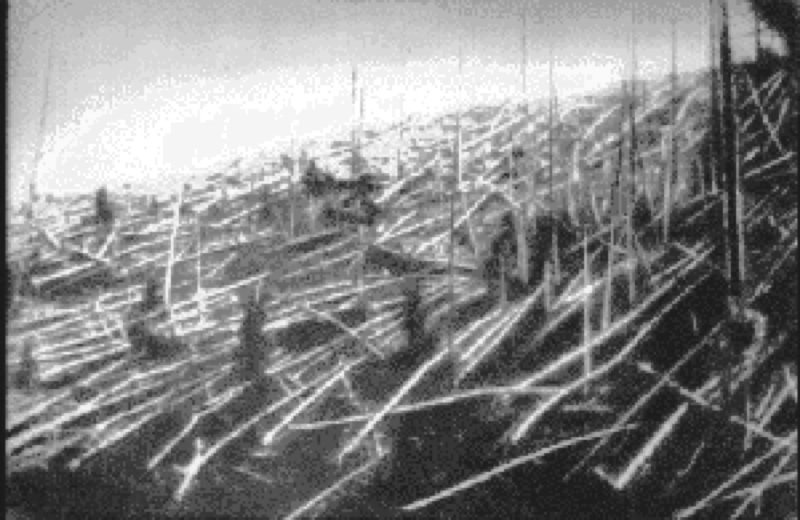
Tunguska
I later read that a tornado had passed through the area that night. That must have been what we’d heard.
I in my tent was like the first of the Three Little Pigs in his house of straw. North Carolinians in their wooden houses were like the second pig. But as we know from the story — and from Christopher Walken’s humorous rendition of it — the third pig in his brick house was the one who fared best.


